
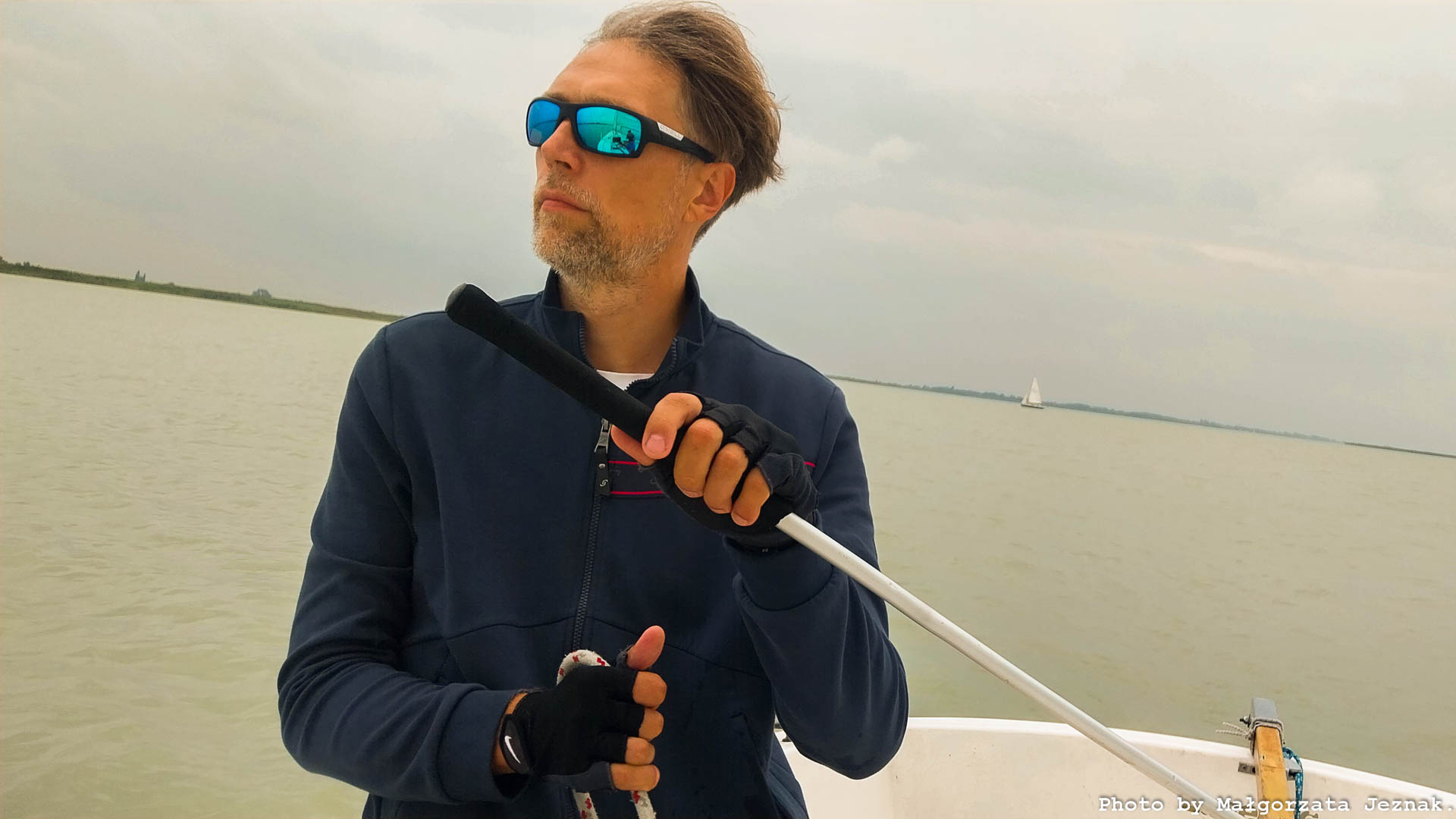
Close-hauled and Broad reach
Due to a kind of work frenzy, I failed this year to plan my vacation in time. On Friday, the final day of my professional efforts before a 16-day absence agreed upon with my employer, I still had no idea where to go—let alone any preparations for the trip. Hotel prices—those with vacancies and willing to accept large dogs—were causing me mild respiratory distress, especially given the decidedly poor posture I assumed while browsing offers. The expected August heat practically ruled out my dog Lajf as a travel companion, since he simply cannot stand high temperatures. So the next morning, Saturday, I returned to the idea of spending my vacation differently this time—by joining a course at the nearby sailing school [1] .
Basic Course
My knowledge of seafaring had so far been limited to bits of information picked up over the years while passionately reading about great geographical discoveries—both ancient and Renaissance. As for sailing itself, I knew virtually nothing. All the more reason to be excited about spending five days at a sailing school on Lake Neusiedl (German: Neusiedler See)—located on the border between Austria’s Burgenland and Hungary’s Győr-Moson-Sopron County, just a 45-minute drive from my home—learning the basics of operating a sailboat, both in theory and, of course, in practice.
From the very first day, I had the joyful opportunity to steer a single-mast, double-sail boat of the sloop type (German: Jolle). Over the first five days of lessons, I learned about wind directions, boat maneuvers, and the structure of the vessel. My knowledge was, naturally, superficial, and my experience modest—but I quickly realized I was standing at the edge of a sea of possibilities, or rather an ocean of sensations. Sailing, after all, has a tradition stretching back thousands of years, and learning its principles is a breathtaking journey—not this time because of a stiff seated posture, but quite the opposite: due to the considerable effort required to control the boat amid changing wind strength and direction, which demands constant movement on deck.
Advanced Course
As planned, I spent the second week deepening my knowledge and repeating basic maneuvers: casting off from the jetty, executing turns, retrieving an object that had fallen overboard, and returning to the dock. Thanks to a well-written manual [2],
whose author happened to be the instructor of my basic course, I felt confident and made progress using a mobile app designed to prepare students for the exam. For a moment, I considered studying in my native language—Polish—but I quickly abandoned the idea when I discovered how confusing the mix of technical terms could be. For instance,
- a turn (in sailing: Tack) from upwind to upwind again (point of sail: Close-hauled)—say, from 10:30 to 1:30—is called a “Wende” in German, simply meaning “turn.” But a similar maneuver with the wind (point of sail: Broad reach), say from 4:30 to 7:30, is a “Halse.” In Polish, it’s exactly the opposite! A series of tacks from upwind to upwind again is called “halsowanie,” while the German “Halse” corresponds to the Polish “zwrot przez rufę” (a tack through the stern);
- Equally amusing to me is the German term “Backstag”—a rope connecting the top of the mast to the stern of the boat—which, in its Polonized form “Baksztag,” actually refers to a wind direction (Broad reach).
The Exam
As Friday of the second week approached—the day of the late-afternoon exam—I studied more intensely using the manual and the app, and practiced tying sailing knots. I also used the hours spent sailing on the lake to repeat maneuvers over and over until I finally felt I had control of the boat. This was especially important given the weather phenomenon known in German as a “Bö”—a sudden gust of wind that can capsize a boat if handled by an inexperienced sailor.
To my concern, the day of the exam turned out to be so windy that the representative of the Austrian Sailing Association (German: Österreichischer Segel-Verband / OeSV [3]) seemed to be considering postponing the test. Fortunately, I was able to proceed. After 6:00 p.m., the wind had settled into the permissible range of 4 to 20 knots [4] (approx. 7.4 to 37 km/h). After successfully completing the assigned tasks and passing the theoretical test, I received my sailing certificate that same evening. (It’s not a document issued by a government authority, but it is recognized in Austria and many other countries as a valid basis for renting a boat or insuring your own.)
The Takeaway
For me, as a computer technician, the time spent actively at the sailing school turned out to be more than just a unique vacation. The greatest value was opening my mind to a way of thinking I hadn’t known before. Specifically, the contrast between the order imposed by modern technology—visible, for example, in the arrangement of icons on a computer desktop or in binary code, the zero-one logic—and the natural diversity and a kind of freedom, which at this stage of my development I can feel more than I can describe.
Perhaps a comparison will help—sailing versus driving a car, which is likely more familiar to most readers.
- A car moves along a designated, narrow lane. The driver often passes close to other vehicles, especially in the city. Road signs—horizontal, vertical, and light-based—regulate traffic. Fueled by gasoline, the vehicle has brakes;
- A sailboat knows none* of this.
As a car driver—and also as a systems administrator—I seem to be in control: I can stop a 1.5-ton vehicle relatively quickly and easily, or run a script on a device—a small computer program that does exactly what it was designed to do. On a sailboat, however, I am just a delicate creature, dependent on the strength and direction of the wind. And the wind blows when and where it pleases.
* There are signs comparable to road traffic signs – horizontal ones (e.g. buoys), vertical ones (e.g. boards), and light signals (e.g. identification and position lights) – but a sailboat encounters them relatively rarely.
External links
to German-language materials:
- [↑] boats2sail.com
- [↑] Grimm, Michael; Hampl, Anton. BFA Guide. Der Weg zum Befähigungsausweis Binnen (A-Schein). Wien: Mehrwasser GmbH, 2022.
- [↑] segelverband.at
- [↑] PDF 0,8 MB: Die Prüfungsordnung für Prüfungen zum Erwerb von Bfa-Binnen & JRL zur Führung von Segelfahrzeugen. S. 7.
Meta

