
Rovás
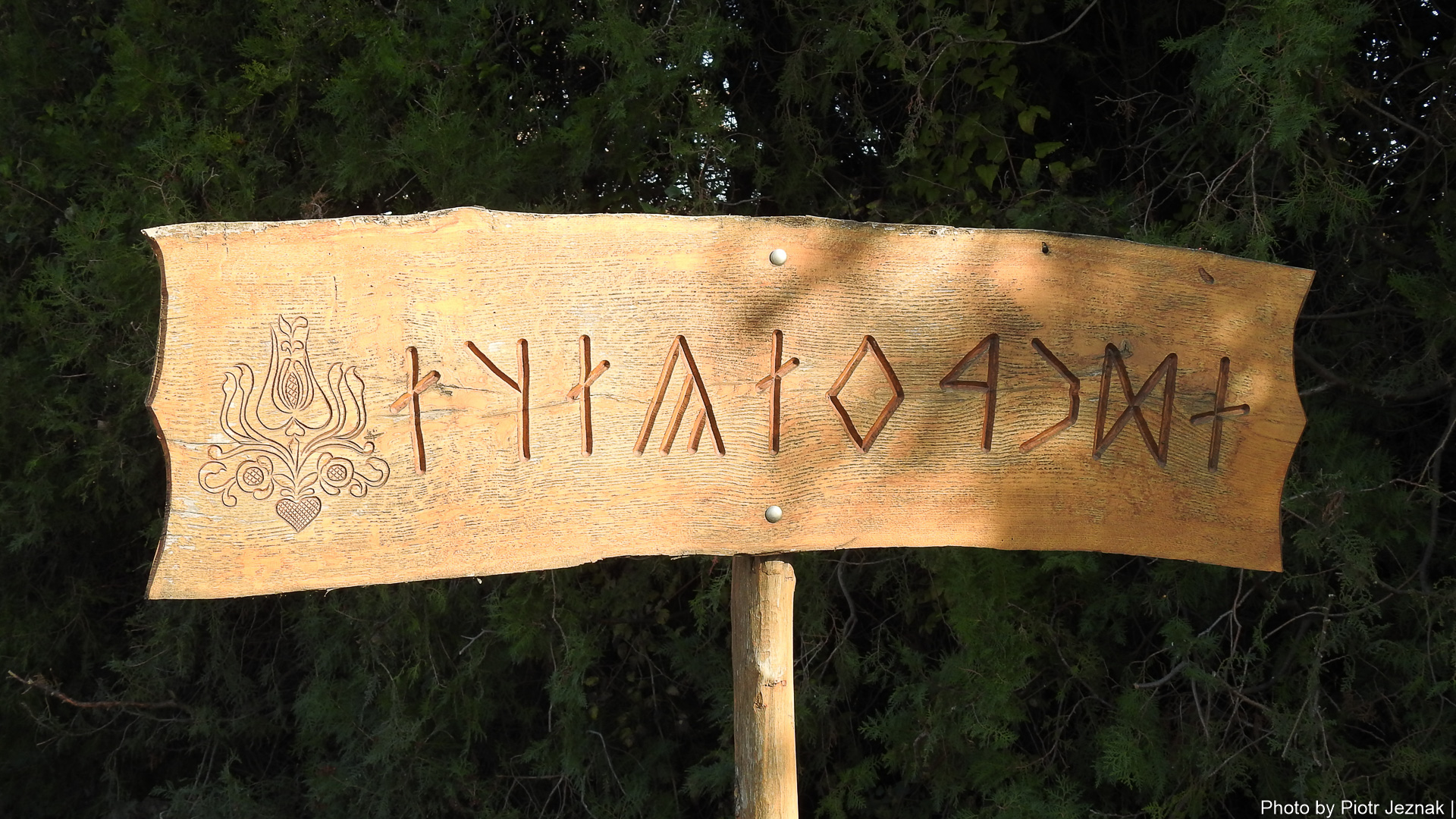
It was one of those car journeys where you first have to leave Vienna on one of its arterial roads, racing along such a route for about three quarters of an hour, only to happily turn off and continue at a slower pace towards towns and villages far removed from the highways. After passing through stretches of Lower Austria, Burgenland, and the Bratislava districts of Jarovce and Rusovce, I entered Hungary, reaching the county of Győr-Moson-Sopron—first passing through Rajka, then arriving at the outskirts of the village of Dunakiliti. There I stopped and got out of the car to take a closer look at a mysterious entrance sign [1]. Only later did I realize that I had been looking at Rovás (Old Hungarian script; Hung. rovásírás).
Entrance signs to Dunakiliti
My actual destination was the Csebi‑Pogány Palace, located within Dunakiliti. Yet the wooden entrance sign to the village captivated me, because at that time its inscription did not resemble any alphabet I knew. Comparing it with the village name on the standard sign next to it, I noticed a certain pattern: where the wooden sign on the left side of the name showed three repetitions of a character resembling the Polish letter “ł”, the regular sign displayed three instances of the vowel “i” on the right side of the name. Could it be that this enigmatic script was read from right to left?
Rovás
As I later discovered at home, thanks to the Internet Library of Eternal Self‑Learning and the assistance of the Audacious Interference (AI), this runic or runiform alphabet was used by the Hungarian tribes particularly until the year 1000 AD, when Stephen I became the first crowned king of Hungary and soon introduced the Latin alphabet.
Rovás, as an alphabet, also consisted of signs assigned to sounds. Some letters were combined into so‑called ligatures, words were separated by three vertical dots, and capital letters were used only – and not always – for proper names. Indeed, Rovás was written and read from right to left, and sometimes even in boustrophedon style, meaning the first line began on the right, the next on the left, and so on alternately.
Rovás survived as a script until the 19th century in Transylvania. Today it is the subject of research by historians, linguists, cultural organizations, and associations of rovásírás enthusiasts. The entrance signs to Dunakiliti, of which I managed to find two written in Rovás, were probably erected at the initiative of the local municipality – part of the contemporary revival of interest in this medieval alphabet, which was fortunate enough to survive in memory and even remain legible.
External link
- [↑] Google Street View showing the entrance sign to Dunakiliti with the village name written in the Rovás alphabet.
