
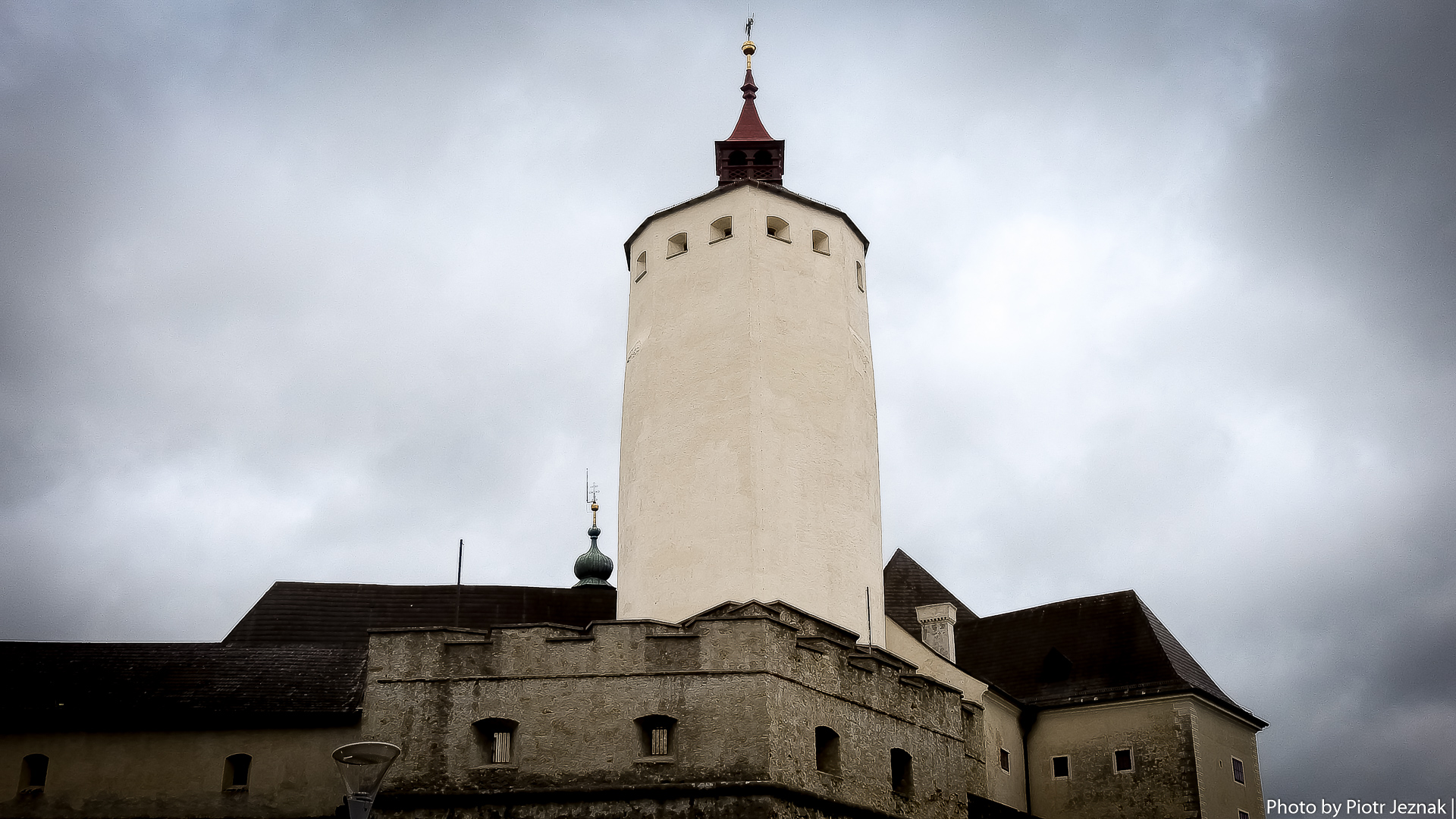
The teardrop-shaped cross-section of a keep
Forchtenstein Castle, located in the heart of Burgenland, one of Austria’s nine states, is one of the most well-known and popular sights in the region. Accessible from the east only by driving a serpentine stretch, it opens its sole gate on the western side. Here, near the main entrance, the monumental walls and a keep (donjon) with its teardrop-shaped cross-section, appear subjectively even larger than from the perspective of the Burgenland expressway S31, about 6 km away.
The Black Tower keep
Originally built in the later Middle Ages, the fifty-metre-high fortified tower, with walls up to seven metres thick – the Black Tower, a defining feature of Forchtenstein Castle – has no windows. The openings at the top, known as embrasures, were primarily used to observe the castle’s surroundings and point to the tower’s purpose as a place of last defence, known as a donjon (These defensive towers were not permanently inhabited). What is surprising, however, is its cross-section: a teardrop shape, which is most clearly visible from the west. As you can guess, this design was intended to minimize the impact of artillery shells. When fired from the west – where approaching the castle and setting up cannons was easiest – the shells would ideally slide sideways rather than hitting the turret with full force.

Forchtenstein Castle – view from the east. In the foreground the clock tower, in the background the keep (donjon).
In the book Traumschlösser. Die Schlösser und Burgen Österreichs [1] an illustration of the Forchtenstein Castle keep can be found, showing various windows – large and small – suggesting that the tower was once inhabited. Although the graphic lacks a description, the bastions of the outer defensive system indicate a date no earlier than the mid-17th century. Furthermore, the keep is mentioned in the text and compared to a ship’s bow by its prow.
Further examples
of a teardrop-shaped cross-section of the keep can be found in
- Germany:
- Falkenstein Castle (Burg Harz);
- Poland:
- Bolków Castle (Zamek w Bolkowie);
- Czechia:
- Bítov Castle (Hrad Bítov),
- Castle Strakonice (Hrad Strakonice).
References
- [↑] Plechl, Pia Maria; Trumler, Gerhard. Traumschlösser. Die Schlösser und Burgen Österreichs. Wien: Molden Verlag, 1979, p. 114.
- [↑] Ibid., p. 115.
Cover photo
The teardrop-shaped cross-section of the keep of Forchtenstein Castle, recognizable only from the eastern side. Also look at the close-up of the clock on the clock tower.
